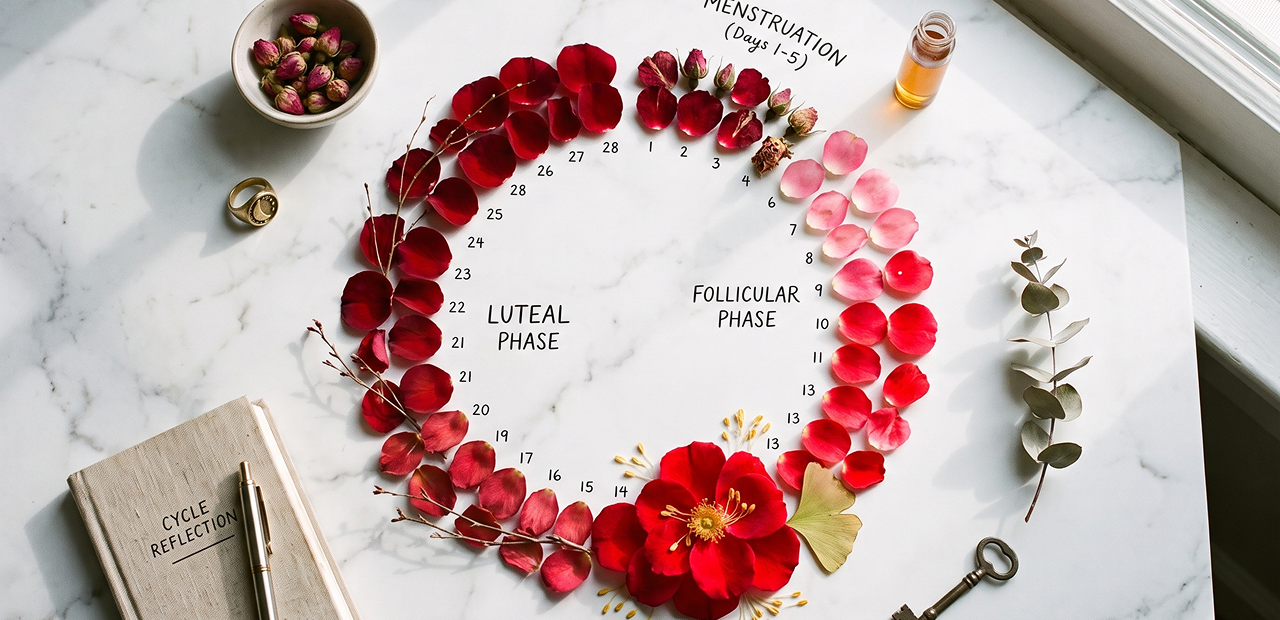
Understanding Your Menstrual Cycle: The Four Phases

Share
Understanding Your Menstrual Cycle: The Four Phases

In this article, we'll cover:

Understanding Your Menstrual Cycle: The Four Phases

Your menstrual cycle is a vital part of your reproductive health, governed by a complex interplay of hormones. Knowing what happens during each phase can help you anticipate changes in your body and emotions. Here’s a breakdown of the four key phases of the menstrual cycle:

The Menstrual Phase (Menstruation)

What It Is: Commonly known as your period, this phase marks the official start of your menstrual cycle.

Duration: Menstruation typically lasts between three to seven days.

Process: During this phase, the lining of your uterus sheds through your cervix and vagina, resulting in menstrual blood flow. Interestingly, the average total amount of menstrual blood is about a quarter of a cup.

The Follicular Phase

Purpose: This phase prepares your body for potential pregnancy.

Hormonal Changes: Estrogen signals the uterine lining to thicken, while follicle-stimulating hormone (FSH) stimulates the growth of ovarian follicles, each containing an egg.

Ovulation Readiness: Usually, one egg will mature for fertilization, and estrogen levels rise dramatically, peaking just before ovulation. In a typical 28-day cycle, ovulation occurs around day 14.

The Ovulation Phase

Key Event: A surge in estrogen triggers a spike in luteinizing hormone (LH), leading to the rupture of a follicle and the release of a mature egg.

Timing: Ovulation generally occurs 11 to 16 days before your next period, with day 14 being common in a regular 28-day cycle.

Egg Journey: The egg travels from the ovary through the fallopian tube toward the uterus, where the uterine lining continues to thicken in preparation for a potential pregnancy. The egg remains viable for fertilization for about 24 hours.

The Luteal Phase

Post-Ovulation Changes: After ovulation, the empty follicle transforms into a corpus luteum, which produces estrogen and high levels of progesterone.

Uterine Preparation: Progesterone prepares the uterine lining for a fertilized egg.

Outcomes: If fertilization occurs, the egg implants in the uterine lining, and pregnancy begins. If not, hormonal levels drop, leading to the shedding of the uterine lining, and your period starts, signaling the beginning of a new cycle.

Additional Resources

For more detailed information, you can refer to the following sources:

  • ACOG Patient Brochure 049
  • ACOG Patient Brochure on Midlife Transition and Menopause
  • ACOG Medical Student Education Module 2008
  • Comprehensive Gynecology by Mishell, Stenchever, Droegemueller, and Herbst
  • Textbook of Histology by Bloom and Fawcett
  • Pediatric and Adolescent Gynecology by Emans, Laufer, and Goldstein

Understanding these phases can empower you to manage your menstrual health more effectively.

Product Recommender